Google Play Ranking Factors: What 183 Top 10s Show
We read the top 10 apps for 183 real Google Play searches and measured what they share: keywords in the title, installs, ratings, updates and app age.
· 8 min read
In this study
- Key findings
- 1. For short searches, the title matters
- 2. Long searches work differently
- 3. Bigger apps rank higher, but size isn't everything
- 4. Small apps get in, and they lean on their title
- 5. A rating of 4.0 or more is the norm
- 6. Almost every ranking app is maintained
- 7. Repeating the keyword doesn't go with higher positions
- Other things we noticed
- What this means for your app
- Method and limits
Google doesn't publish how Google Play ranks apps in search. Most lists of "ranking factors" repeat the same advice without showing any data. So we looked at the results themselves: the top 10 apps for 183 real Google Play searches, and what those apps have in common.
The study covers 1,824 ranking spots held by 861 different apps, read in the US on November 3, 2026. The method and its limits are at the end.
Key findings
- For short searches, the title matters. For searches of one or two words, 43% of top 10 apps had the exact search in their title, and 55% of the apps ranked #1.
- Long searches work differently. For searches of three words or more, only 3% of ranking apps had the exact phrase in their title, and 47% didn't contain every word of the search anywhere in their listing text.
- Bigger apps rank higher, on average. The median app at #1 had 65.3 million installs, against 8.5 million at #10. But the most installed app in the top 10 was #1 in only 18% of searches.
- Small apps get in, and they lean on their title. Apps with under 100,000 installs held 6% of all spots, and appeared in the top 10 of 32% of searches. They had the exact search in their title more than twice as often as apps with over 100 million installs.
- A rating of 4.0 or more is the norm: 93% of ranking apps had one.
- Almost every ranking app is maintained: 86% had been updated in the last 90 days.
- Repeating the keyword doesn't go with higher positions. Apps used the exact search a median of three times in their full description, whether they ranked #1 to #3 or #4 to #10.
1. For short searches, the title matters
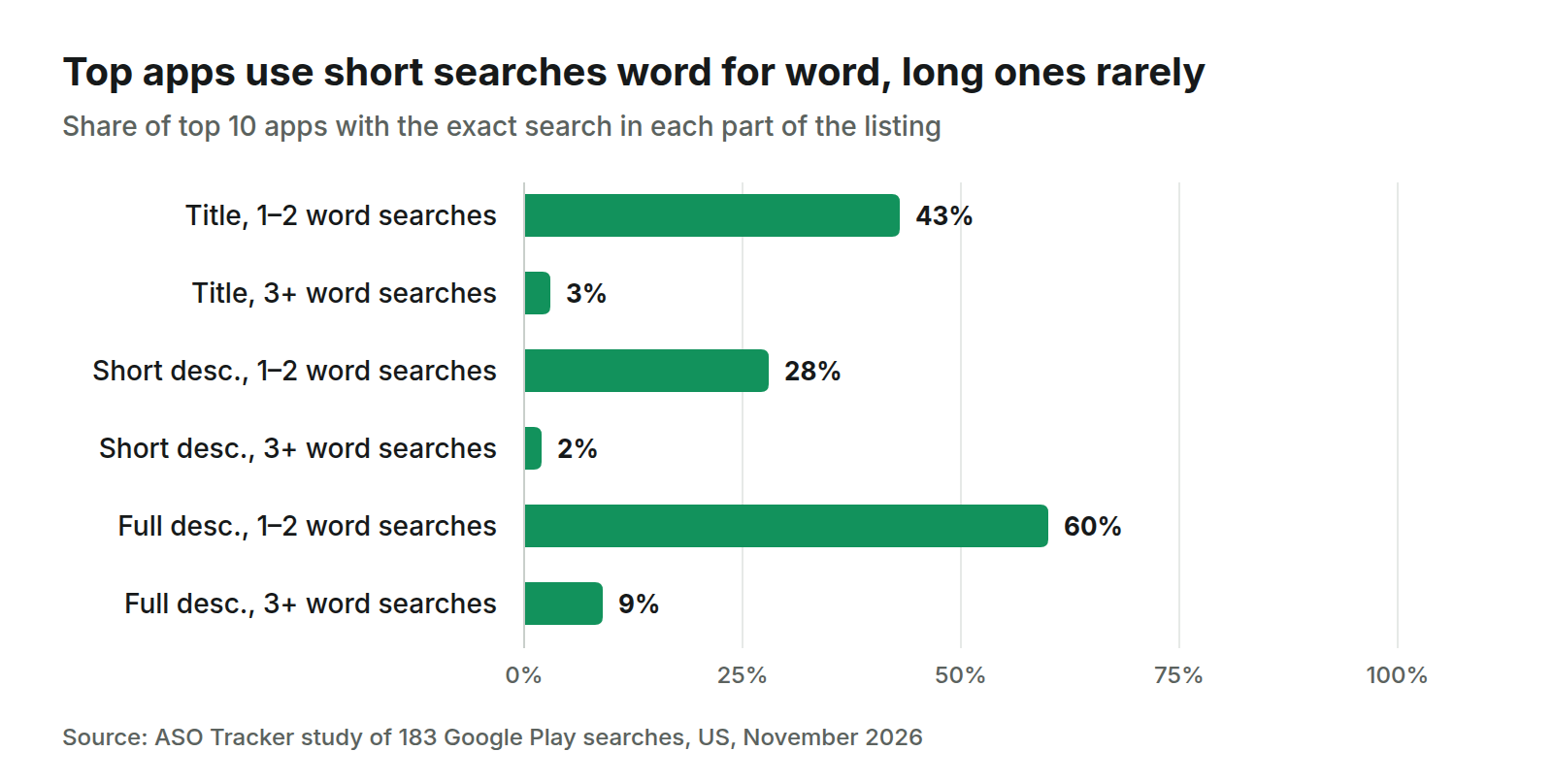 For short searches, the exact search is in 43% of titles. For long searches, in 3%.
We split the 183 searches into short ones of one or two words, like "chess" or "habit tracker" (47 searches), and longer ones like "puzzle games for kids" (136 searches).
For short searches, the exact search was in the title of 43% of top 10 apps, in the short description of 28%, and in the full description of 60%. The share grows near the top: 55% of the apps ranked #1 had it in their title, against 43% at #2 and #3, and 41% from #4 to #10.
Many #1 apps simply say what they are. "Hidden Object Games: Seek It" was #1 for "hidden object games". "Chess - Offline Board Game" was #1 for "chess offline". "Loop Habit Tracker" was #1 for "habit tracker".
2. Long searches work differently
For searches of three words or more, the exact phrase almost disappears: 3% of ranking apps had it in their title, 2% in their short description, and 9% in their full description. Nearly half (47%) didn't contain every word of the search anywhere in their title or descriptions.
Take "puzzle games for kids". The #5 app was Block Blast!, a block puzzle whose listing doesn't mention kids. For "cooking games 2026", the #1 app was Cooking Madness, which never mentions the year.
Google Play seems to understand what a long search is about, and then lean on other signals to rank the apps that fit. The practical lesson: you don't need a sentence for every long variant of your keyword. Cover the core words ("cooking game") and the modifiers that are true for your app ("offline"), and leave the rest.
3. Bigger apps rank higher, but size isn't everything
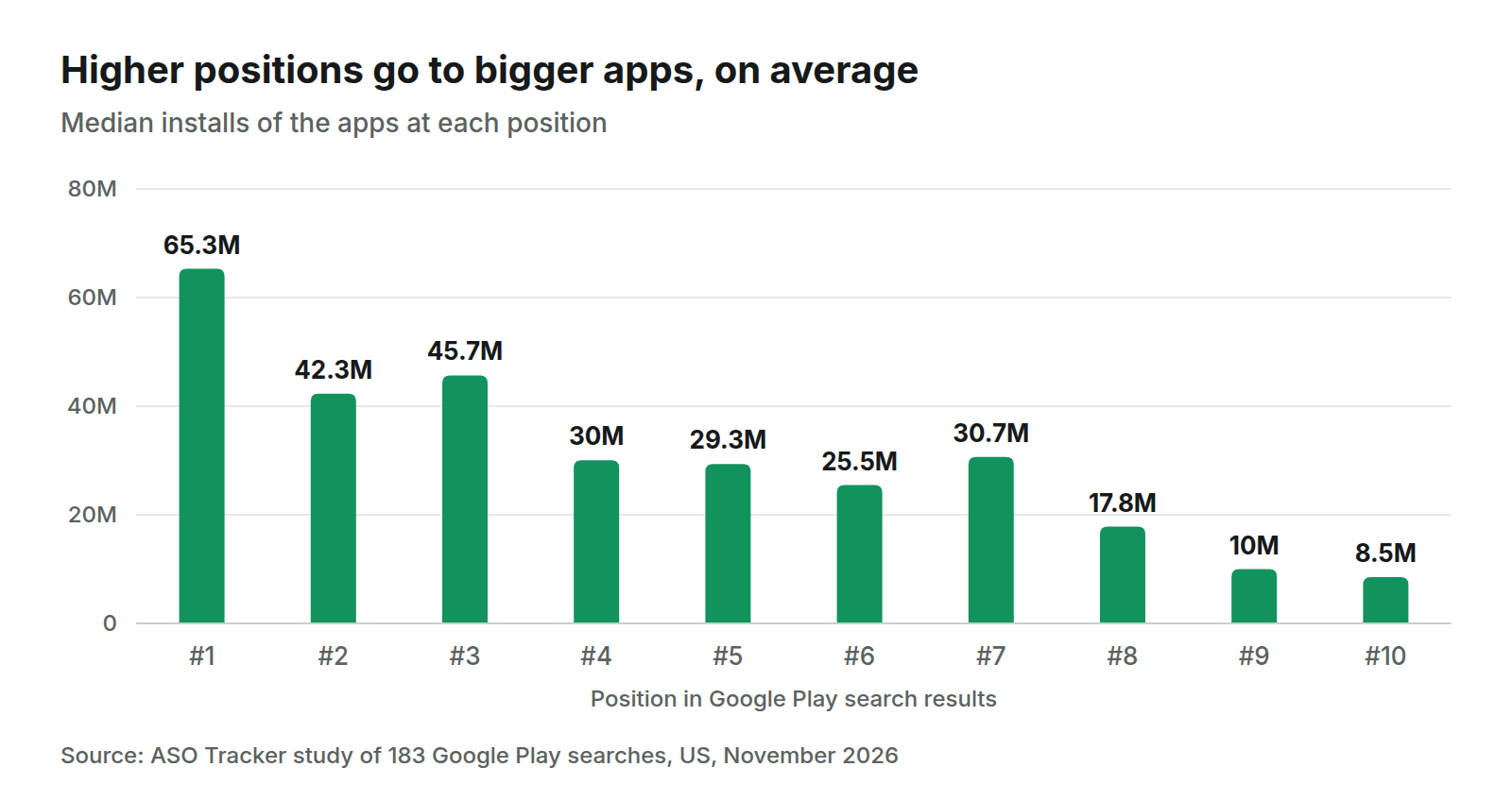 Median installs fall from 65.3M at #1 to 8.5M at #10.
The median app at #1 had 65.3 million installs. At #10, it had 8.5 million. The number of ratings followed the same slope: a median of 616,000 at #1, against 114,000 at #10.
So popularity counts. But it doesn't decide alone: in only 18% of searches was the most installed app of the top 10 the one at #1. Measured search by search, the link between installs and position was moderate at best (a rank correlation of 0.24 on average). Relevance, ratings, and how people react to an app in each search all seem to weigh in.
There's also a chicken-and-egg problem here. Apps that rank well get more installs because they rank well, so part of this pattern is the result of ranking, not its cause.
4. Small apps get in, and they lean on their title
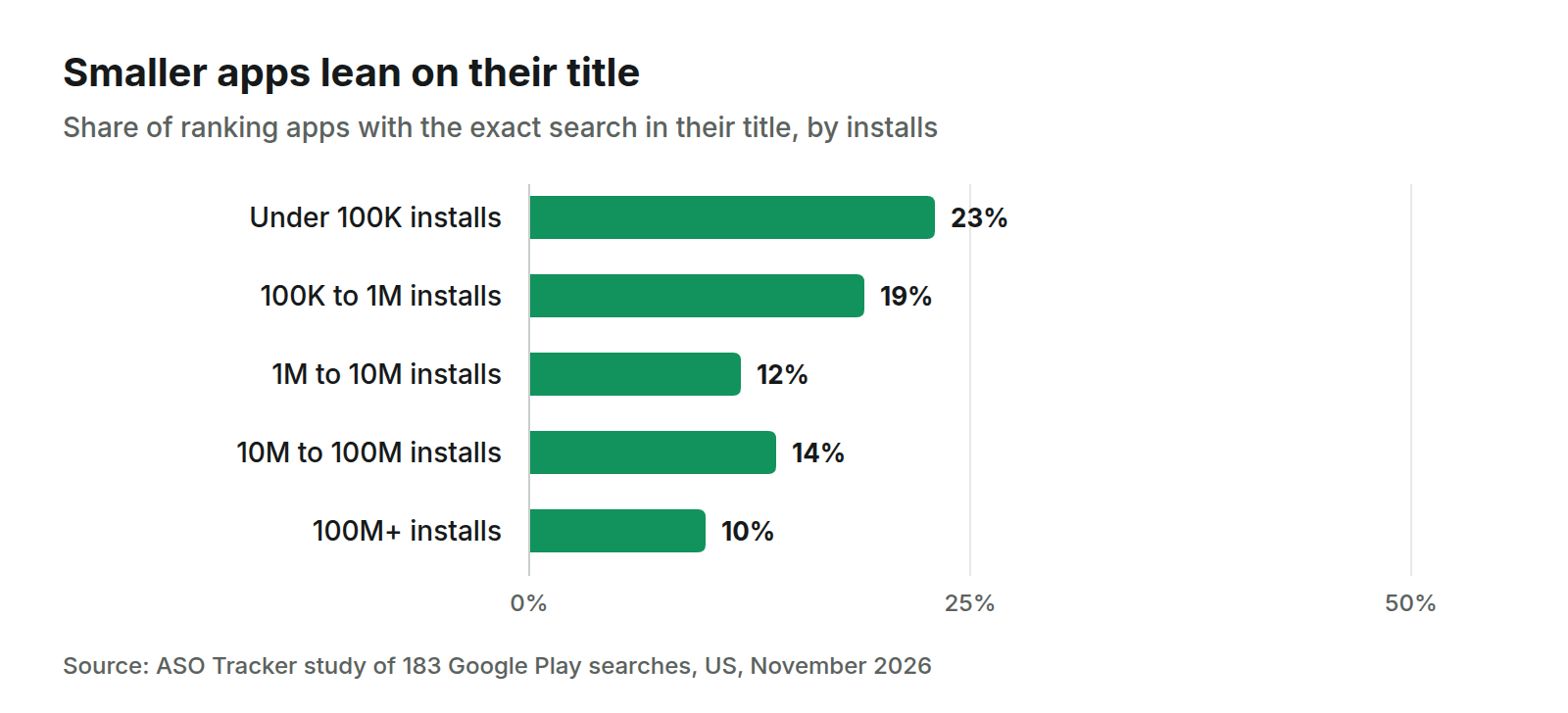 Apps under 100K installs had the exact search in their title in 23% of cases, against 10% for 100M+ apps.
Apps with under 100,000 installs held 115 of the 1,824 spots, or 6%. That sounds small, but they were spread out: at least one of them appeared in the top 10 of 32% of the searches, and in the top 3 of 10%.
Those small apps had the exact search in their title in 23% of cases, against 10% for apps with over 100 million installs. On short searches the gap holds: 52% for apps under one million installs, 37% for apps over 100 million. Big apps rank on their size and their name. Small apps rank on relevance, and their title is where they show it.
Eleven searches even had an app with under one million installs at #1. Three examples:
| Search | #1 app | Installs | Rating | Released |
|---|---|---|---|---|
| idle games | Luck Architect: Idle Clicker | About 31,000 | 4.66 | August 2026 |
| horse games | Pocket Horses: Racing Champion | About 239,000 | 4.55 | June 2026 |
| tower defense | 2112TD: Tower Defense Survival | About 278,000 | 4.69 | 2020 |
Two of the three were released in 2026, and all three have a rating above 4.5.
5. A rating of 4.0 or more is the norm
Only 7% of ranking apps had an average rating below 4.0, and that share was the same in the top 3. The median rating was 4.71 at #1 and 4.56 at #10.
The average rating was more weakly linked to position than installs were (a rank correlation of 0.16). It works more like an entry ticket: with a rating under 4.0, your app is the exception in a top 10. And the rating is also what people see next to your icon when they decide what to install.
6. Almost every ranking app is maintained
74% of ranking apps had been updated in the 30 days before the study, and 86% in the last 90 days. Only 4% hadn't been updated for more than a year.
The share was the same in the top 3 (87% updated within 90 days) and from #4 to #10 (86%). So regular updates don't seem to push an app higher on their own; they're simply what ranking apps look like. An app left untouched for a year stands out, and not in a good way.
7. Repeating the keyword doesn't go with higher positions
Among apps with the exact search in their full description, the median app used it three times. That was true for apps at #1 to #3 and for apps at #4 to #10. Nine out of ten used it 12 times or fewer.
There's no sign here that repeating a keyword more often helps. Google's metadata policy warns against repetitive keywords anyway, so a few natural mentions are enough.
Other things we noticed
- Titles use the space they have. The median title was 27 characters out of 30, and two thirds used 25 or more.
- Ranking apps are old. The median app was 8.1 years old. Only 8% of the spots went to apps released in the last 12 months, and 3% of the top-3 spots.
- Preview videos don't change the picture. 44% of ranking apps had one, at the top as well as lower down. A video can still win installs once people are on your page; it just doesn't show up as a ranking pattern.
What this means for your app
- For your main short keyword, put the exact phrase in your title. It's the clearest pattern in the data, and the most common one among #1 apps.
- For long searches, cover the core words and the true modifiers in your descriptions, rather than writing every variant.
- If your app is small, pick searches where small apps already rank. Check the top 10 before you commit: a third of searches had at least one app under 100,000 installs.
- Keep your rating above 4.0, and ask for reviews at the right moment.
- Update regularly. It won't lift you on its own, but almost every app around you does it.
- Mention each keyword a few times, naturally. More doesn't help.
- Measure your own app. These are averages across many searches. Track your keywords before and after each change to see what works for you: here's how to check your rankings.
Method and limits
- Searches. We typed 40 seeds (20 game genres and 20 app categories, like "puzzle game" or "budget planner") into Google Play's search bar and kept the first five suggestions for each: 200 real searches. We removed 17 that were brand names or odd repeats, like "solitaire cash", "car parking multiplayer 2" or "zombie games zombie games", which leaves 183.
- Results. For each search, we read the top 10 apps on the Google Play website, signed out, in the US and in English, on November 3, 2026. One search returned only four apps, so the total is 1,824 spots, held by 861 different apps.
- Listings. For each app, we read its public store page the same day: title, short and full description, installs, ratings, last update and release date.
- Matching. "Exact search" means the words of the search, in the same order, ignoring capitals, punctuation and a plural "s". "Every word" ignores small words like "for" and "with".
- Limits. This is a correlation study: it shows what ranking apps have in common, not what causes their rankings. It covers one country, one language and one day. Google Play personalizes results for signed-in users, so individual users may see a different order. And Google uses signals we can't see from outside, like how often people install an app after searching for something, and whether they keep it.
Try it on your own app
ASO Tracker checks your Google Play rankings every day, finds the keywords people search and scores your store listing. Start free with 200 credits, no card needed.
Keep reading
Google Play Feature Graphic: Size, Rules and Examples
The Google Play feature graphic is 1024 × 500 px, JPEG or 24-bit PNG. Where it shows, the design rules Google gives, and real examples that work.
November 3, 2026 · 5 min readGuide· VideoHow to Check Your App's Ranking on Google Play
Where does your app rank in Google Play search? Three ways to check, from a quick look to daily tracking, and what to do with the numbers.
November 3, 2026 · 5 min readGuide· VideoHow to Find Keywords for Your Google Play App
Find the keywords people really type on Google Play, tell the easy ones from the hard ones, and put them where they count. A free method, step by step.
November 3, 2026 · 6 min read